Sunday, 30 December 2007

The Demilitarized Zone (DMZ)

Yesterday some of the teachers headed up north to the DMZ (the 4 km-wide demilitarized zone which stretches along the entire Korean peninsula at the 38th parallel, dividing North and South Korea.) I was hesitant to go, feeling strange about going to the border of a country where the people are starving to death, and the soldiers will shoot you for pointing or smiling at them. Perhaps even stranger was going on a tour which was hosted by an American army group and the American army itself. I found myself wondering whose propaganda I should believe.

We all met at 5:15am, got a cab to the subway station, then rode the subway for an hour to get to the USO in Seoul. As we walked into the building, I couldn't help but recoil from the sight in front of me; it was America, bottled and splashed all over the room. From the flag covered walls to the pictures of large-breasted women in American flag-inspired outfits, it was all topped off by more overweight, buzz-cut American tourists than I could handle. I thought for a minute that I had wandered into the Mid-West, and it took all of my will-power to keep moving forward. With deep, yogic breathing I managed to get to the counter to show my passport and board the bus. When the Korean tour guide asked who wasn't American, I threw my arm into the air with such vigour that I almost broke my hand on the ceiling.

The bus took us an hour north to an army base at the border of the DMZ, where we were "briefed" by a very straight-shooting American soldier. He explained about how the DMZ came to be and the many rules we must follow while on the tour, including absolutely no pointing or attempting to communicate, verbally or non-verbally, with the North Korean soldiers. We also signed a waiver that said South Korea (and indeed all of the countries of the United Nations), were still at war with North Korea, and no one could take responsibility if we got caught in the crossfire. Very comforting.

After the briefing we boarded an army bus with a pretty down-to-earth soldier/tour guide who actually had a sense of humour. Our first stop was the JSA (Joint Security Area) where the UN patrols the South side and North Koreans patrol the North.

The grey building below is the N. Korean headquarters. The little blue buildings are where the UN and N. Korea have their diplomatic talks. The blue buildings are actually on the border, so that when you go half way through the room you're suddenly in N. Korea. The man in green is a ROK (Republic of (south) Korea) soldier.
Close-up of a N.Korean soldier watching us from his side with binoculars.Two ROK soldiers guarding the S. Korea side with our tour guide in front.This ROK soldier looks like he's staring at the wall, but in fact he is positioned there for hours, only showing half of his face so that if the N.Koreans open fire he can get cover more easily.
In one of the little blue UN buildings. I am standing in N.Korea with a ROK soldier guarding the door to N.Korea. I sort of felt like if I opened that door I would step into Narnia... well if I could get past this guy first...
In the blue UN building; our feet in North Korea!This is the door to North Korea. It is unlocked during the day, but at night ROK soldiers lock it. Our guide told us that one time when a soldier was locking it a N. Korean opened the door and pulled him into N. Korea. From that point on one ROK soldier would stand with his left hand on the wall and his right on the pistol of the soldier locking the door in front of him. This, the guide said, was why the wall was white; from the soldiers placing their hands there each night. I'm not sure if he was making this up or not... sorta feel like he was... cause why do the S. Koreans get to lock the doors? A ROK soldier protecting the UN flag in the UN building. (Taken from the North side)
At the end of the Korean War the POW's from both sides were released and told that they could all choose whether to stay in the country they were in, or go across this bridge to the other side. Once they chose though, they could never go back. Hence, this bridge is called the "Bridge of No Return".This is a N. Korean village bordering the DMZ, referred to as "Propaganda Village" because no one lives in the village except soldiers, and until 2004 propaganda was blared from the loudspeakers 12 hrs/day. Look at the 3 and 4 story buildings below and then look up at the flag. The flag is mammoth, and the "pole" was built to trump the pole in the South Korean village across from it. Which it does, standing 160 meters high.
At noon we went to a rather crappy Korean restaurant for lunch, then headed to the Infiltration tunnels. The tunnels were made by the North in the 1970's, just about the time they started their peace talks with the South.

We walked through the 3rd tunnel all the way to the N.Korean border, which was quite the trek. Unfortunately we weren't allowed to take pictures, but the tunnel was quite the site to behold, bored through bedrock, about 5.5 ft high and wide enough for 30,000 troops and field artillery to reach S.Korea in one hour. There are four tunnels in total, the last having been discovered in 1994, which caused wide-spread panic, as it enters S.Korea at a point only 44 km from Seoul.

The third tunnel, which we walked through. It was very damp, as it is under a river.
The positions of the four tunnels:After all of this excitement we boarded our original bus back to Seoul. The entire way back they showed a Hollywood version of the Korean War, but luckily I was so tired that I had no problem falling asleep :)

It's Christmas!

I woke up on Christmas morning in a terrible mood because I had to work. The highlight of the day was the Secret Santa gift I received: a set of acrylic paints, a pad of paper and drawing pencils! It was wicked.

After school things started looking up because we had a huge Christmas feast planned. I put on my eating dress (it balloons out at the stomach, hiding a multitude of sins), and headed over to Shanda's, who was hosting the event. Somehow, she managed to fit four stuffed chickens in her toaster oven, and had also made six pies. By 7:30pm every surface in Shanda's apartment was covered. There were mashed potatoes, scalloped potatoes, deviled eggs, six types of bread, Christmas pudding, pumpkin pie, apple pie, AND if all that weren't enough, a huge tray of deli meat, cheese, and dill pickles brought from one of the many American army bases (you can't get those things anywhere else in Korea). Oh yes, and a lot of liquor.

I ate too much, which is very unusual for me :D

Four chickens in an oven just a touch bigger than a toaster oven:
Hmmm deli meat and cheeeeeese... I haven't had it in three months! There was even Feta and smoked Gouda!
Part of the group devouring the feast (There were 16 of us total)

Hwaseong at night - December 15

On December 15th I met up with Ericka Wicks from Truro and one of her Korean friends. She is leaving in two weeks and Hwaseong Fortress was one of the few touristy things she hadn't seen yet. So, having only been to Hwaseong once, and wanting to see her before she left, we met up.

By the time we actually got to Hwaseong it was night-time, but it was beautiful:

Ericka and I:Ericka's friend Sean and I at a cute cafe near the fortress:

Tuesday, 11 December 2007

Weekend in Gyeongju

This past weekend, seven of the teachers from Happy Suwon English Village set out on a journey to Gyeongju, a city in Gyeongsangbuk province (Suwon is in Gyeonggi province).

A map of our travel route
We travelled to Gyeongju by bus, which took exactly 4 hrs. I brought enough snacks to feed a small army, so Rupali, Mike, Nick and I spent almost the entire ride eating. Poor Collin, Hannah and Pip were at the front of the bus; too far away to partake in the snacking.

We arrived late Friday night, so we found a cheap motel ($25/night each, 2/room), had some food and went to bed. Early Saturday morning we went to Bulgulksa, a Buddhist Temple that was a 20 minute bus ride from our hotel.

The entrance to the main hall, which has 33 stairs, representing the 33 stages of enlightenment.
A turtle with a large Drum on his back
View from the mountains above Bulguksa (at the entrance to the Seokguram Grotto) In the distance you can see the Sea of Japan!
The Seokguram Grotto. Sakyamuni Buddha sits in a rotunda in the mountain behind the building, surrounded by over three dozen guardians and lesser dieties. Both the room he is in and himself are carved out of solid granite. Unfortunately he was behind a pane of glass, and we weren't allowed to take pictures
A roof tile that we bought to commemorate our visit. When the caretakers replace the tiles on the roofs it will go up!
During the Shilla Dynasty (4th Century), important people were cremated, and their urns were placed in burial mounds (such as these shown below), along with miniature versions of the objects the used in life (like the pyramids). This picture was taken from on top of one of the mounds (yes I know, I'm defacing Korean history... but there weren't any signs saying not to go up!)The group (minus Collin) in front of one of the mounds
On our second day we decided to hike up Samneung, which is part of Central Namsan Mountain. All along the mountain there were Buddhas carved out of the rock face, and little altars set up in front of them. As well, all of the plants and trees were labeled so that you knew what everything was.

Pine trees at the beginning of the hike up SamneungA Buddhist monk's chant, emanating from these speakers, was a great inspiration to keep going at the half-way mark. Too bad it wasn't a real monk!When we got to the temple where the speakers were, almost everyone decided to stop, but Nick, Mike and I pressed on and went all the way to the top. Halfway up there was a huge Buddha carved from granite on the side of a cliff. The ground below was polished granite, and a woman sat praying there on the edge of the cliff.

Buddha carved out of granite, near the top of Samneung
A Korean woman praying to the granite Buddha

To get to the very top of the mountain we had to pull ourselves up with ropes, but it was well worth the extra effort. The view was incredible!!

Can you see me? That's Mike, Nick and I on top of the boulder! This was taken by Rupali down below at the temple where the speakers were!
Nick perched on a boulder at the very top
View from the very top
After our hike we hurried back to our hotel, picked up our bags, and headed to the bus terminal. We caught the 4:20pm bus to Seoul, and got back to the apartment at 10:30pm. It was a wonderful trip.

Sunset on the bus ride back to Suwon

FREE ROBERT LATIMER

Hi all!

This is a slightly different post then my usual, and it really has nothing to do with my adventures in Korea, but it is very important. Please read!

Robert Latimer, a farmer working a spread in Saskatchewan northwest of Saskatoon, killed his 12-year-old daughter Tracy on October 24, 1993. There has never been any doubt about this.

Latimer told police he did it. He said he loved his daughter and could not bear to watch her suffer from a severe form of cerebral palsy. So he placed her in the cab of his Chevy pickup, ran a hose from the exhaust to the cab, climbed into the box of the truck, sat on a tire and watched her die.

Tracy was a 40-pound quadriplegic, a 12-year-old who functioned at the level of a three-month-old. She had been repeatedly operated on and at the time of her murder was due for more surgery, this time to remove a thigh bone. She could not walk, talk or feed herself, though she responded to affection and occasionally smiled. Tracy was in constant, excruciating pain yet, for reasons not entirely clear, could not be treated with a pain-killer stronger than Tylenol.

On November 4, 1993, Latimer was charged with first-degree murder. A year later, he was convicted of second-degree murder.

For more info:
-Excerpt from an article from CBC News. To read the full article go here http://www.cbc.ca/news/background/latimer/
Robert Latimer's Official Site - http://www.robertlatimer.net

Please go and sign the petitions to free Robert Latimer:
http://www.ipetitions.com/petition/freerobertlatimer/
http://www.freerobertlatimer.ca/#

Thank you friends and family!

Monday, 3 December 2007

An Exhilarating Change in Perspective

During my first few weeks here I complained bitterly that I couldn't find the food I was used to cooking, and that everything I cooked at home was either too expensive or simply not available here. At the time, the older teachers told me to just go to the supermarket with a couple of ideas of what I might like to cook, and pick out ingredients that were less expensive and substitute them for what I would usually use. I strongly resisted this idea, grumbling that I should be able to make whatever I wanted whenever I wanted...

...then it hit me.

What a close-minded way to think...

...and I decided to give their suggestion a shot.

What I have discovered in the past month is that going to the supermarket and buying what is available is, for several reasons, a far better way to go about shopping and preparing food. First, what is available in Korea is what is in season. Unlike in a North American grocery store, you can't find strawberries in the winter, or even apples in the summer. What's more, what isn't grown in Korea either isn't here at all, or is astronomically expensive. I can't buy the expensive stuff because I'm on a budget, so I am forced to look for the more economical things, which are the things that are in season and are grown locally. This of course means that it's a good way to shop for the environment, everything tastes wonderfully fresh, and, obviously, it's easy on the pocket book. BUT, the very best thing is that I am experimenting for the first time ever! Instead of thinking, "Oh, I want chicken tonight," then finding a recipe, then getting the ingredients, then following the recipe, I am just going to the store, picking out the fruit and veggies that are the cheapest, throwing them together with a bit of this and that, and finding that everything always tastes great! I have become a good cook, not just a good imitator.


So, before I leave you, I'll tell you about what I made tonight. In the grocery store near my house there are ladies throughout the store who cook samples on little red electric skillets. One thing that I have tried several times and always enjoy is stir fried tofu dipped in egg. I tried it tonight and it was delish! A great way to make tofu! And so easy! For veggies, I stir-fried spinach with baby tomatoes, onion, garlic, and zucchini.
Simple, cheap, dericious. Yes, I said dericious.

Sunday, 2 December 2007

Leeum Samsung Museum of Art - December 1st

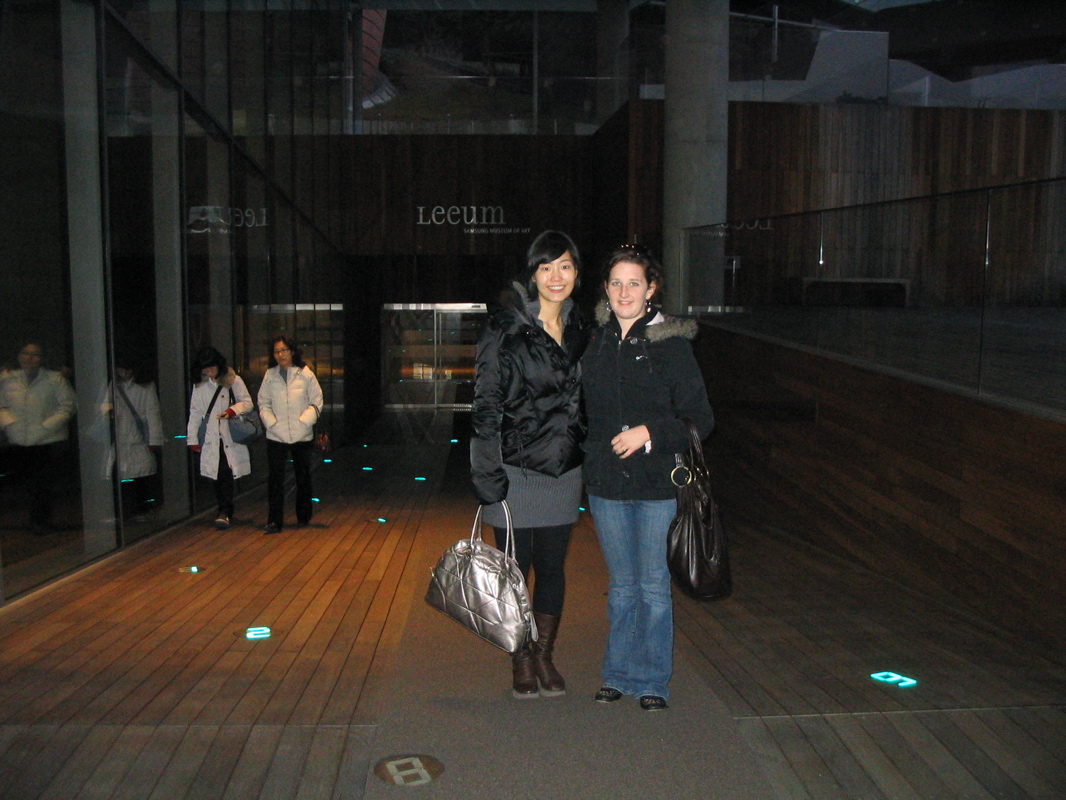
On Saturday, I met up with Seung Yeon in Seoul and we went to the Leeum Samsung Museum of Art. It was definitely a gallery worth checking out, as the architecture of the building was stunning, and for $10 you could get an English speaking docent to take you around on a 2 hr tour of the museum. The docent was great, because there were only four of us on the tour and she was able to explain all of the history and thought-processes behind the work, as well as answer my (many, *sheepish laugh*) questions.

Museum 1 was all traditional Korean art, beginning on the fourth floor with Celadon, then Painting and Calligraphy, then Buddhist art. Museum 2 was both Modern and Contemporary Korean and Foreign Art, including 3 large Rothkos!!

Seung Yeon in front of a French artist (whose name I've forgotten) giant spider sculptures, which represent female strength and frailty
One of the Museum's buildings
Sitting on an eye
Seung Yeon and I in front of the Museum entrance
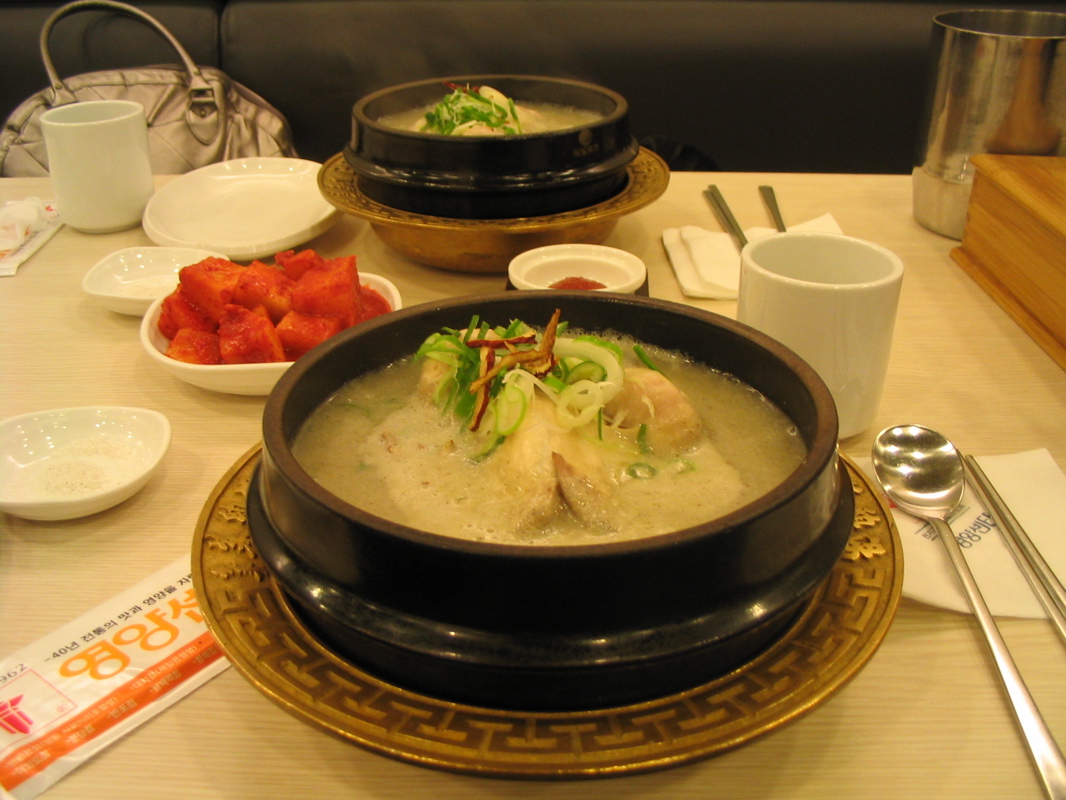
After finishing at the museum, Seung Yeon and I went for a traditional Korean supper called Samgyetang, which is soup that has an entire Game Hen in it, stuffed with rice and Ginseng and Dates. You tear off the chicken with your chopsticks and dip it in a bowl of salt. When the chicken is all gone you eat the broth. It is BIG meal, but very good.

Samgeytang